The specimen ladder
Service 08 · Selection room · Malvern
Kitchen benchtops, compared surface by surface
The benchtop is the surface you touch every day and the one every other decision defers to — cabinet colour, splashback height, sink type, even where the joins fall. Rather than describe materials in adjectives, this page sets five of them on the same ladder and compares them on the four things that actually change how a kitchen lives: look, wear, maintenance and what each is genuinely best used for.
Reading before deciding? Start with the benchtop materials guide.
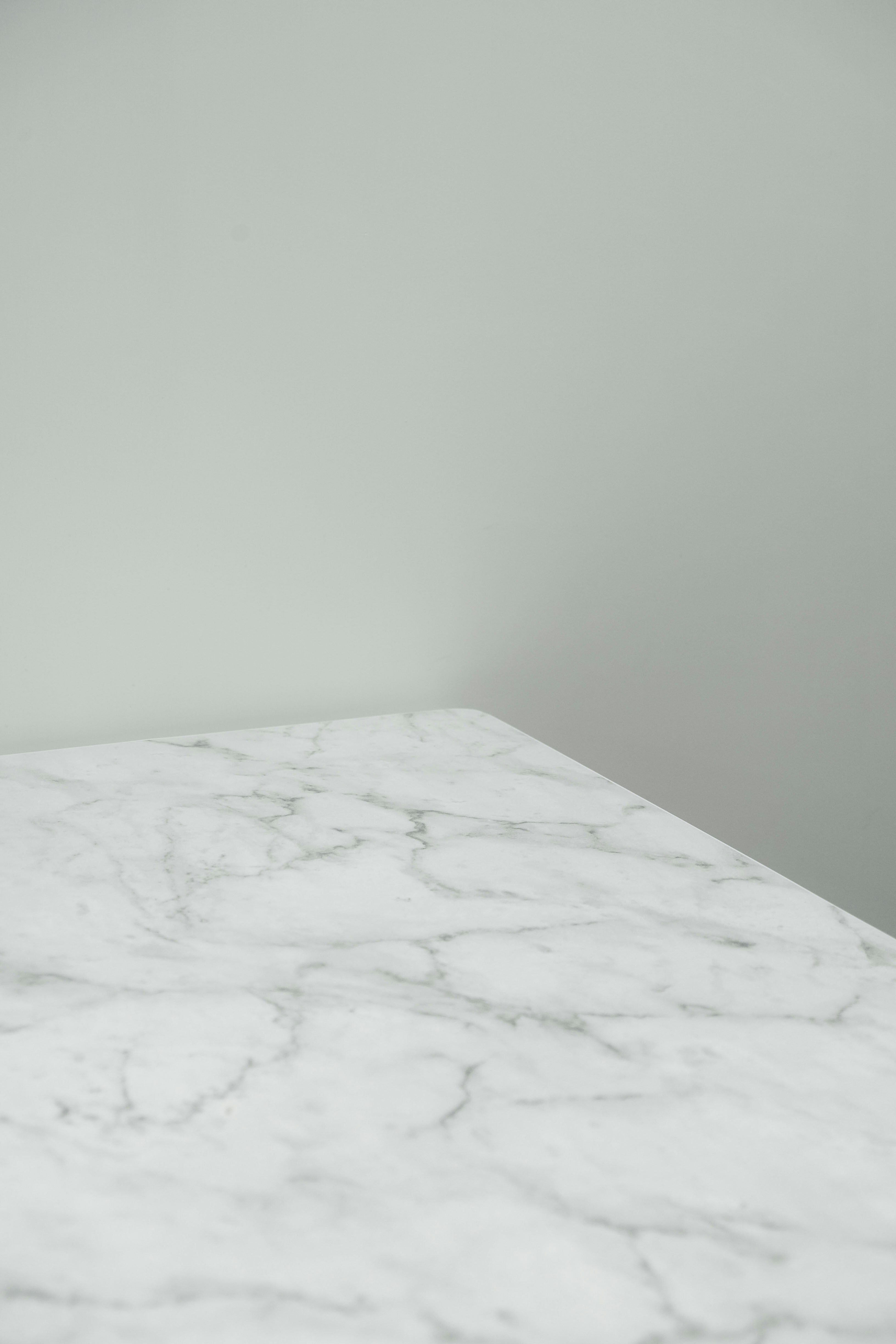
Reference photograph · soft grey veining in a white marble surface, shown to illustrate figure and tone
Five surfaces, judged the same way
Most benchtop conversations stall because the options are described in different terms — one by its price, one by its veining, one by its warranty. Put side by side on identical criteria, the choice usually resolves itself within minutes.
What follows is that comparison. Bring a door sample and a splashback option to it if you can: stone reads completely differently against a matt cabinet front than it does against gloss, and against a tiled splashback than against a full slab return.
01
Quarried slab
Marble · granite
Natural stone
Quarried slab · 20mm or 30mm · honed or polished
LookVeining never repeats. Two slabs from the same block can be book-matched across an island, and the join becomes a deliberate line rather than a flaw.
WearHard and heat-tolerant. Marble is porous and etches where acid sits — lemon, wine, some cleaners. Granite is considerably less reactive.
MaintenanceSealed at installation and resealed periodically. Spills wiped rather than left. Etching and light marking can be honed back by a stonemason.
Best used forHouseholds who read patina as character, and for a single island where the slab itself is the reason for the room.
02
Mineral composite
Slab format
Engineered surfaces
Composite slab · 20mm typical · consistent batch colour
LookPredictable. Pattern and tone repeat slab to slab, which matters when a long run, an island and a butler’s pantry all have to match.
WearDense and stain-resistant in daily use, but heat-sensitive — a pan straight off the cooktop can mark the binder. Trivets, always.
MaintenanceNo sealing. Warm water and a non-abrasive cleaner. Availability of composite products in Australia is governed by current safety regulation, so what can be supplied is confirmed at material selection rather than assumed.
Best used forUninterrupted runs, matched multi-zone kitchens, and anyone who wants a stone look without watching the surface for marks.
03
Sintered sheet
12–20mm
Porcelain
Sintered sheet · thin profile · matt or satin
LookA surface printed on a very dense body. Thin sheets give the crisp 12mm profile that suits handleless joinery; matt finishes read closest to honed stone.
WearThe toughest of the five for heat, scratching and UV. The vulnerability is mechanical — a sharp knock to an exposed arris or a cut-out corner.
MaintenanceNon-porous and never sealed. Wipe clean. On patterned sheets, the decoration is surface-deep, so deep chips show the body beneath.
Best used forHard-working family benches, benchtop-to-splashback continuation, alfresco runs, and slim mitred profiles.
04
Solid or laminated board
Oiled finish
Timber
Staved or solid board · 26–40mm · oil or hardwax
LookWarmth and grain in a room otherwise made of hard surfaces. It is the one benchtop that visibly ages, darkening slightly with oil and light.
WearDents, scorches and marks. Standing water at a sink cut-out is the real enemy, so detailing and sealing around any tap or bowl has to be exact.
MaintenanceRe-oiled on a rhythm you set by use. Uniquely, it can be sanded and brought back in place rather than replaced.
Best used forIsland tops and breakfast bars, secondary runs, pantry shelves — often paired with stone on the wet run.
05
Decorative sheet
On substrate
Laminate
Decorative sheet · postformed or square edge · wide decor range
LookFar better than its reputation. Current decors and textured finishes carry stone and timber convincingly; the giveaway is usually the edge, so choose that profile carefully.
WearScratches under a blade and will chip at a cut-out. Water reaching an unsealed join in the substrate is what ends a laminate top.
MaintenanceEffectively none, but damage is replaced rather than repaired — which is also why it suits scopes that will change again.
Best used forInvestment properties, laundries and butler’s pantries, and makeovers where doors and tops are refreshed over sound carcasses.
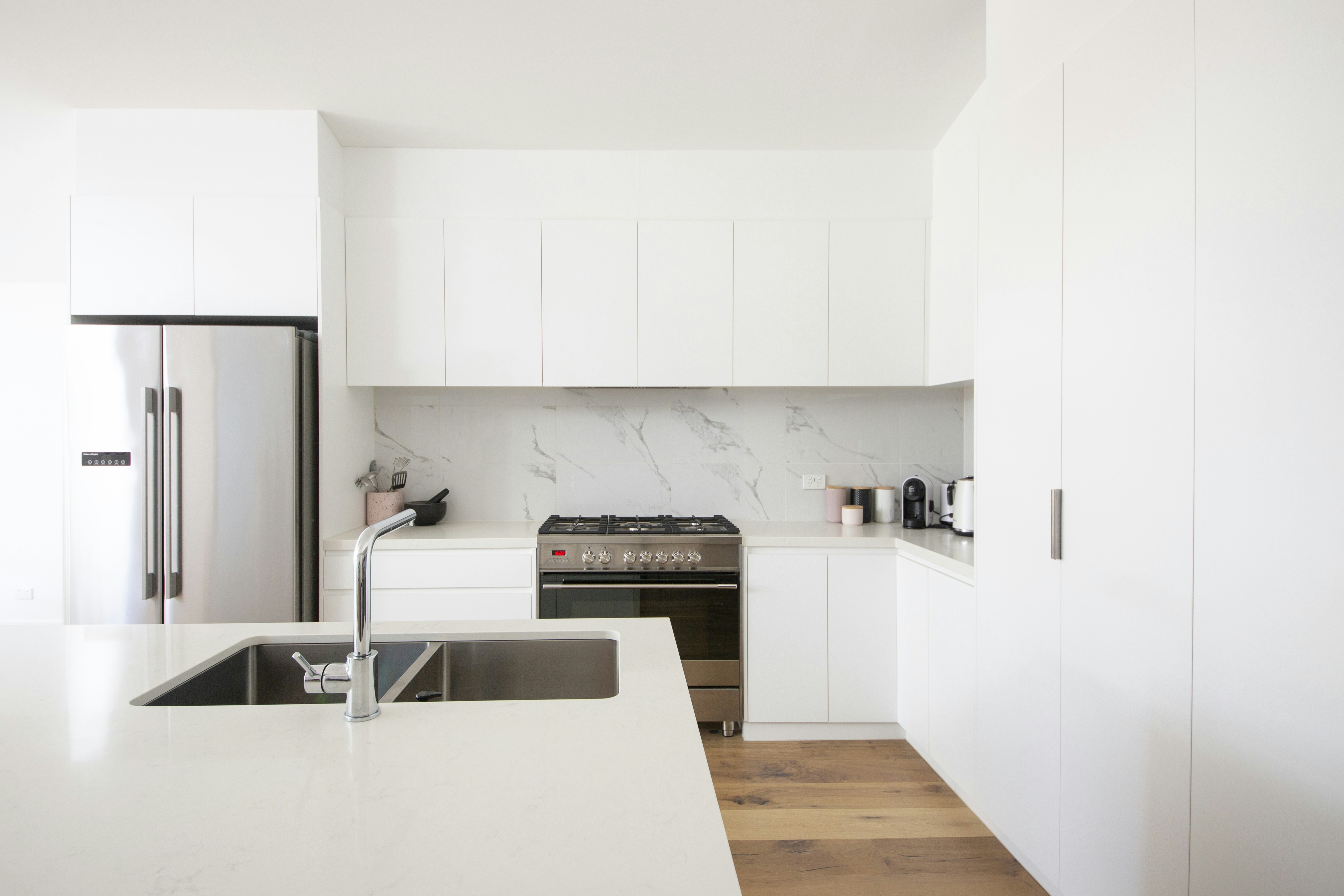
Reference photograph · thin-profile tops, undermount double bowl and a slab return carried up the wall
Thickness, edges and everything cut into the slab
Two kitchens in the same material can look nothing alike, because the difference sits in the profile, the returns and the cut-outs. These are the decisions worth making deliberately rather than defaulting.
Profile
A 20mm top with a square or pencil edge is the quiet standard. A mitred apron folds the slab down to read as 40mm, 60mm or more without the weight of solid stone — the mitre line is the detail to inspect, since a tight one is close to invisible and a poor one never stops being noticed.
Waterfall & returns
A waterfall end carries the top to the floor and, in a veined material, the grain can be mitred so the pattern turns the corner continuously. The same thinking applies vertically when the benchtop material runs up the wall as a slab splashback.
Sinks & cooktops
Undermount bowls wipe straight through and suit stone, composite and porcelain. Drop-in sinks widen the material options and simplify replacement later. Integrated bowls in the same surface give the cleanest line and the least tolerance for error. Drainer grooves, tap holes and flush cooktop rebates are all set at template stage.
Templating & joins
Templating happens after the cabinetry is installed and levelled, never from the plan — walls in Malvern’s period houses are rarely square. Join positions are agreed at that visit: away from the sink and cooktop where possible, at a natural break in the run, and with the veining matched across the seam.
Sealing, care and the questions that come up
Which benchtops actually need sealing?
Natural stone does, at installation and again over time. Composite, porcelain and laminate are non-porous and are not sealed. Timber is finished with oil or hardwax and re-oiled by the household.
Can I put a hot pan straight onto the bench?
Porcelain handles heat best. Natural stone tolerates it well. Composite and laminate can be marked by direct heat, and timber scorches — use a trivet as a habit regardless of material.
Where will the joins be, and will I see them?
Join positions are set at templating and shown to you before fabrication. They are placed away from wet and hot zones where the run allows, colour-matched and polished back — visible on close inspection, not from across the room.
Can the benchtop be replaced without new cabinets?
Often, if the carcasses are sound and square. That is the core of a kitchen makeover; where the layout also needs to move, it becomes remodelling or a complete renovation.
Next step
Bring the shortlist to a quote
Tell us the room, the run lengths you think you have and the two or three surfaces you keep returning to. We work through benchtops in Malvern, Malvern East, Armadale, Toorak, Glen Iris, Kooyong, Prahran, South Yarra and Caulfield North.